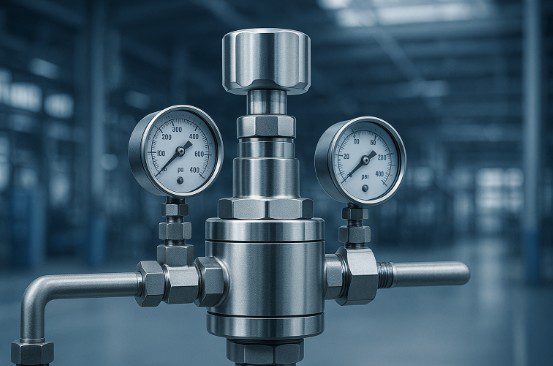
Turbine Meter vs. Other Flow Meters: Coriolis, Ultrasonic & Magnetic Compared

Accurate flow measurement is the backbone of many industries, from oil & gas distribution to water treatment and chemical processing. Whether measuring liquids or gases, companies rely on flow meters to ensure safety, efficiency, and compliance.
One of the most trusted solutions is the turbine meter, widely used as a gas meter in custody transfer and distribution networks.
But with newer technologies like Coriolis, Ultrasonic, and Magnetic flow meters gaining traction, the question arises: How does a turbine meter compare to these alternatives?
This guide breaks down their differences, advantages, and limitations to help engineers and decision-makers choose the right solution.
What Is a Turbine Meter?
A turbine flow meter works on a simple mechanical principle: fluid or gas passes through a chamber, causing a rotor (turbine) to spin. The speed of rotation is proportional to the flow rate, which is then translated into electrical pulses and displayed as volume.
Key features of turbine meters:
- Accuracy: typically ±0.5% to ±1%
- Repeatability: ±0.1%
- Best for: clean, low-viscosity fluids and gases
- Applications: natural gas metering, petroleum pipelines, aviation fuel, and power generation
👉 Learn more in our Turbine Meter Guide or explore the ELGAS Turbine Gas Meter and SURE Turbine Gas Meter.
Why Compare Turbine Meters to Other Flow Meters?
No single flow meter type is “universal.” Each has trade-offs in accuracy, cost, installation, and maintenance. By comparing turbine meters with Coriolis, Ultrasonic, and Magnetic meters, engineers can:
- Select the right technology for their process.
- Avoid overpaying for unnecessary features.
- Ensure compliance with standards such as AGA (American Gas Association), OIML, ISO, and API.
- Improve long-term reliability and reduce downtime.
Turbine Meter vs. Coriolis Flow Meter
How it works:
- Turbine meter: Measures volumetric flow via rotor speed.
- Coriolis meter: Uses vibrating tubes; detects mass flow by measuring how fluid inertia changes tube oscillation.
Comparison:
Feature | Turbine Meter | Coriolis Meter |
Measures | Volumetric flow | Mass flow directly |
Accuracy | ±0.5–1% | ±0.1–0.2% |
Best for | Clean gases & fuels | High-value fluids, custody transfer |
Cost | Lower | Very high |
Maintenance | Needs calibration | Minimal but sensitive |
Industries | Gas distribution, aviation fuel | Pharma, food, oil & gas |
Example:
- A gas utility may choose a turbine meter for cost-effective custody transfer.
- A pharmaceutical plant producing liquid medicines may prefer a Coriolis meter due to its mass-flow accuracy.
Turbine Meter vs. Ultrasonic Flow Meter
How it works:
- Turbine meter: Rotor rotation = flow measurement.
- Ultrasonic meter: Sends sound waves across fluid; measures time difference to calculate velocity.
Comparison:
Feature | Turbine Meter | Ultrasonic Meter |
Measures | Volumetric flow | Velocity converted to volumetric |
Accuracy | ±0.5–1% | ±0.5% (advanced models ±0.2%) |
Maintenance | Moving parts require servicing | No moving parts |
Installation | Inline | Inline or clamp-on (non-intrusive) |
Cost | Medium | High |
Best for | Clean fluids & gases | Large pipes, corrosive/dirty fluids |
Example:
- Industrial boiler feedwater: turbine meter is sufficient.
- Municipal water pipelines: ultrasonic meters are ideal due to non-intrusive installation.
Turbine Meter vs. Magnetic Flow Meter
How it works:
- Turbine meter: Mechanical rotation.
- Magnetic meter: Applies Faraday’s Law—voltage induced as conductive fluid flows through a magnetic field.
Comparison:
Feature | Turbine Meter | Magnetic Meter |
Measures | Volumetric flow | Conductive liquid velocity |
Accuracy | ±0.5–1% | ±0.2–0.5% |
Limitations | Struggles with dirty/viscous fluids | Cannot measure gases/non-conductive fluids |
Maintenance | Needs calibration | No moving parts |
Industries | Oil, gas, aviation | Water treatment, slurries, chemicals |
Example:
- A refinery measuring natural gas uses turbine meters.
- A wastewater treatment plant measuring sludge flow uses magnetic meters.
Industry Use Cases for Turbine Meters
- Oil & Gas – Custody transfer of natural gas and refined fuels.
- Power Generation – Measuring fuel gas in turbines.
- Aviation – Jet fuel supply lines rely on turbine meters.
- Utilities – City gas distribution networks.
- Chemical plants – Monitoring feedstock and clean process fluids.
👉 See our Comet ELGAS Turbine Meter datasheet (PDF) for technical details.
Advantages & Limitations of Turbine Meters
✅ Advantages
- High accuracy and repeatability for clean fluids and gases.
- Proven reliability with decades of industry use.
- Cost-effective compared to high-tech alternatives.
- Wide flow and pressure range adaptability.
- Compact, easy-to-install design.
❌ Limitations
- Sensitive to dirty, viscous, or multiphase fluids.
- Mechanical wear requires calibration and periodic replacement.
- Not ideal for low flow rates in very small pipes.
Buyer’s Guide: Choosing the Right Flow Meter
When comparing turbine meters with other types, ask:
- What fluid or gas am I measuring? (Conductive liquid, clean gas, slurry, etc.)
- Do I need volumetric or mass flow?
- How accurate must the readings be? (±1% may be fine for utilities; ±0.1% needed for pharma.)
- What’s the total cost of ownership? (Purchase, calibration, downtime, lifespan.)
- What are the compliance standards? (AGA 7 for turbine meters, ISO 5167 for others.)
- Installation environment: Clean vs. dirty, small pipe vs. large diameter, corrosive vs. inert.
👉 If you’re also comparing turbine meters with paddle meters, see our guide on Turbine vs. Paddle Meter Differences
FAQs About Flow Meters
Are turbine meters suitable for custody transfer?
Yes, turbine meters are widely used for natural gas custody transfer due to their proven accuracy and compliance with AGA and OIML standards.
Do turbine meters measure mass or volume?
Turbine meters measure volumetric flow. For mass flow, Coriolis meters are recommended.
How long does a turbine meter last?
With proper maintenance, turbine meters can last 10–20 years in industrial applications, though calibration is required regularly.
Which flow meter is best for dirty fluids?
Magnetic or ultrasonic meters are better suited than turbine meters for wastewater, slurries, or corrosive liquids.
Why are turbine meters still popular despite newer technologies?
Because they offer the best balance of accuracy, cost, and reliability for gas and clean liquid measurement.
Final Thoughts
Turbine meters remain a reliable and cost-effective choice for measuring gas and clean liquid flows.
While Coriolis, Ultrasonic, and Magnetic flow meters each excel in specific applications, turbine meters continue to dominate gas metering, oil distribution, and aviation fuel monitoring thanks to their accuracy, industry standards compliance, and affordability.
At Comet Integrated, we provide robust, certified turbine meters designed for both industrial and utility applications. Explore our ELGAS Turbine Gas Meter and SURE Turbine Gas Meter or speak with our team for expert advice.
👉 For a deep dive, read our Turbine Meter Guide.